[From a manuscript purported to be among the literary relicts of the estate of Ernest Hemingway. In observance of the 2011 Tour de France which commences this July, as it does each year.]
The Death of the Tour Caterer
That summer it was very hot. In the mountains it was also very hot. The mountain passes held the heat and shimmered in the afternoons. That year we had come for the bicycle racing. It was in the season after Coppi had won his last Giro in the Italian mountains. We had come to the French mountains for the start of this season.
The days were hot like steel. We had come on the train as far as Argentuil where the mountain stages would start, and we sat in the café on the square, moving farther back into the shade as the sun moved. The white wine of Auvergne was cold in the carafe and it was very good.
It will be a good Tour this year, said Burns.
Yes, I said.
Why do you say so? asked the woman.
Because, said Burns. It is being catered by Berthold Infantile again. The creme of all Tour caterers. His fromage roti en croute is a legend on the Swiss team. But for his paté des truffes en brioche he was awarded the Legion d’Honneur.
Yes, I said. It is true.
Berthold Infantile, tour caterer
It’s so hot, said the woman. Order something cold, please.
I turned to the waiter standing in the shade. Garçon, un Campari avec soda et citron, s’il vous plait.
Que? he said
Una Campari con soda y limon, por favor. I said. The Spaniard turned and was gone. When he came back he held the Campari on a round tray. He set it down and the woman took it and sipped it quickly in the heat. I picked up the carafe of wine and drank the straw-colored wine from the neck of the bottle. It was cold and it was very good in the wet bottle.
What is special about Infantile? asked the woman.
For me it is the oeufs en glacée au Brillat-Savarin, said Burns.
Infantile is a genius, I said. He alone is the Tour.
Everyone agrees, said Burns. All the riders agree. When he catered the Giro after the war he found the best wines from nowhere. The war had destroyed the best cellars, but he found the wines anyway. They appeared. Twenty years old some were, some older, premiere crus, deuxieme. He even served a ’24 Chateau d’Yquem to the mechaniques. And he defied the rationing because he refused to set out panoni for the riders. He had found besides the wines some foie gras. The authorities were amazed at his ingenuity. They left him alone because the riders insisted.
Bartali nearly went to jail defending him, I said.
The woman looked bored. She fanned herself in the heat. It was very hot and the wine was very cold. It was good. Burns filled his glass with the straw-colored wine. We both drank the wine and looked away.
Bartali in the mountains, 1937
From the street Bassano the Italian rider came into the plaza of the café. He was lean. He walked over and sat down next to the woman. She moved into the shade. Bassano looked away.
You are riding? I said.
Yes, he said. I am riding. It will be a good Tour, he said. He looked darkly at the woman.
Why, asked the woman. She looked back at him and smiled.
Infantile, he said. Berthold is catering the Tour again this year. Tremendous. The timbales, so heavy you can’t ride afterwards. They will be the deeds that canonize him.
Yes, I said. But the ortolans are very scarce this season. The table de pavé will not be complete without the ortolans, I said.
Bassano looked at me and said nothing. He looked away at the waiter and ordered a beer. It came and it was cold. He drank from the bottle and looked away. He thought of the ortolans which were very scarce that season.
That season the Tour went very slowly in the early stages because of the heat in the plains of the Loire. Burns and I had stayed in the mountains with the woman. We followed the progress of the race each morning in the newspapers that came to the hotel. We read the morning papers and drank the white armagnac of Gascogne in large balloons and ordered pots of the dark coffee and waited for the mountain stages to begin.
Each day as the Tour edged closer to the Mont d’Auvergnais the advance crowds became heavier. Some Spaniards took the floor above our rooms and we heard them drinking Rioja and cognac fundador late into the night. Their cigars glowed on the terrace above our windows and they talked very softly in the night.
The first mountain stage from Pont au Roussel to Point d’Abysse was the stage on which the Englishman Tony Smythe-Whyte had died in the last season. In a twisting descent on the Col d’Epicure his rear wheel caught a bit of the torte flambé des ananas Cointreau that Infantile’s apprentice had dropped on the road while handing it en passant to a Yugoslav domestique. That year the judges nearly ended the Tour catering. But Berthold remained firm. Bartali nearly went to jail defending him.
So Berthold had returned always in the seasons after that one. He was the Tour. No one blamed him for the death of the Englishman. It had happened and it was finished. But he no longer used bananas in his tortes dulces.
Bassano led after the eleventh stage. The Italians kept the pack away from him and he led. When the Tour arrived in the mountains for the twelfth stage Bassano had gained weight.
Bassano has grown fat, I said.
Not fat, said the woman. Perhaps - pudgy.
On the first morning of the mountain stages Infantile’s old lorry parked on the street beneath the hotel balcony. Infantile came from the lorry and walked slowly into the hotel. He came into the bar. He saw me and nodded.
Berthold, I said.
Jack, he said. No, no cognac this morning. I am not well. His voice was low and he looked away.
You are perhaps only tired? But the riders count on you, I said.
Yes, he said looking at me. They count on me. But on whom do I count? On my idiot apprentices? On no one can I count. On whom does Infantile depend? On God alone. Perhaps.
He looked away.
It is true, I said. Have a coffee. The coffee came and it was hot and dark. He looked at the barman and turned away.
The riders, he said. They think they cannot ride without my timbales, without my canard aux marronnes, without my poule de Bresse, my pommes de terres aux Lyons. I give them my soul.
He drank the dark coffee.
Yes, I said. It is true. I looked away.
My very soul, he said. I am tired. Omelettes de porcines, entrecôte de bistek, sole a la mousseline. The riders, they would eat away my soul. I can barely feed the Italian team.
It is for France that you do it, I said.
He sighed. Bassano has grown fat, he said. It is good he rides for the Italians. But I am tired. If it is for France, how do the Italians and the Spaniards win the Tour every season? If I feed them as well as the French am I not a traitor to my country, to my compatriots? Et pourtant . . . .
In the street his apprentices had set the table de pavé. It was covered in white cloths and laid with croissants aux chocolat and buerre au Normandie. The butter was pale and glistened in the crocks. It was cold.
The mountain stage had started below in Saint Apostole an hour before. I waited on the street in front of the hotel. The peloton of the Italians rode in a close line up the street to the hotel. They stopped and put the croissants in their pockets and remounted. Then the Spaniards came, and the Swiss. It happened in this way many times that morning. The butter was no longer cold and it darkened the pockets of the riders’ jerseys.
Raymond Poulidor, Jacques Anquetil
An Italian mechanic from the Molteni squad found him first. When the lingue de boeuf en gelée did not appear at noon farther along the stage route the Italian had gone to Berthold’s room in the hotel. Infantile was lying on his back. His eyes were open and he held the beef tongue over his breast. It had not yet been boiled. His toque blanche hung on the bedpost with a fresh apron.
When his wife was told of his death she looked away. The Tour will never be the same, she said. She did not weep.
He was very sad about the quail after the war, she said. After the war he knew it would not be the same. The quail were scarce and the quality was poor. He said to me that his salmis de caille en port rouge et blanc suffered. The salmis was Blagosevic’s favorite, the favorite of the Bulgarian team, she said. And the ortolans became scarce after the war. Then, of course, there was the Englishman . . . .
She said nothing else.
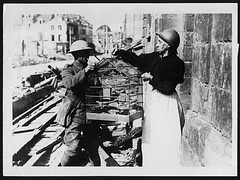
Madame Infantile evacuating ortolans during the war
There was a wake for him in the plaza of the Café d’ Argentuil where the Tour had entered the mountain stages. The riders came and sat in small groups, sitting without order on the café chairs. They did not speak.
Bassano wiped his eyes. He stood up.
The other riders looked at him. He gulped and did not speak. They looked away.
When he spoke he told of winning the Tour in the last season before the war. It was the season when the mechanics were on strike and the bicycles were not kept well. It was before the war and there was no oil for the chains of the bicycles. The pelotons made much noise in that season.
Bassano spoke of the season of no oil when the mechanics went on strike. The riders remembered and they nodded their heads. Some riders looked away.
He spoke of his friend Berthold and of the table de pavé of the great Infantile. He spoke of the timbales. He remembered the ortolans which had not been scarce in those years. It was in those years that the riders gained much weight in the tour because of the table of Berthold, he told them.
He told of how the table of the great Infantile had won the race for him that year. The early stages were easy that season, he remembered. There were plenty of ortolans then, and sturgeon en aspic, and the timbales were filled with the ham of pigs fed on chestnuts, with the truffes noir of Picardy. And the bottles of vins Bordelais were covered with the old dust of the cellars of Saint Emilion.
He remembered every one of Berthold Infantile’s tables des pavés in the lowland stages that season. He remembered each vol-au-vent, each pot-au-feu, he remembered the heaps of ortolans they ate like popcorn at the halts. The langoustes en hollandaise. . . , he said, and he stopped. The young riders waited for Bassano to finish the story of the langoustes. The older riders wept. Bassano looked away.
Then he told them of the mountain stages in that season, how the bicycles made much noise because there was no oil. The bicycles were difficult to ride because there was no oil that year, and the passes were very steep.
I could hear the other riders behind me like locusts, he said. Their chains rasped like swarms of cicadas. I heard them plainly. It was my signal to ride harder. They could not catch me so long as I knew where they were.
He told them of how in the hardest mountain stage the table of Infantile had saved him the race that season.
There I was, he said, the Alpe d’Huez to climb the next day, nothing in my water bottle but the last of the La Tache ’27, and nothing to grease my chain with but the confit au canard.
The widow Infantile could no longer weep. She looked away.
'The Year of No Oil'