Sunday, February 17, 2013

Changed My Mind (About Climate Change)

Since this is already a nation of eedjits on a crash course with the environment, I've decided to change my mind about it all. My position on the question is as follows: the current menu of human cultural and economic activities known generally as global capitalism has already accelerated the warming of the earth's climate past any hope of either arresting or stabilizing it, and to such a degree that the collapse of our recognizable ecosystems, global economies and entire cultures is inevitable sooner rather than later.

"It was that fart in the feedlot that finished them."

Given the long and careful attention of the world's scientific community to the question, given its well-documented consensus, such a claim, to be taken seriously, no longer needs documentation in a rational community (present company excepted), any more than a biologist's claim that conclusions in the biological sciences rest firmly on evolutionary biology, needs documentation. QED, as far as I'm concerned. When time has run out, bullshit doesn't deserve equal time.

I'm not exempting myself from my minuscule part in the responsibility for this impending collapse. After all, I'm a large primate with a utility bill and a monthly gasoline allowance, and I don't kid myself that riding around on my bicycle, as I like to do, is going to save the planet. My rides aren't all that "epic."


But unfortunately, while the realm of established and certain fact is not a democracy, such questions of critical policy require to be put to a vote by the paid industry hacks and suborned shills for corporate influence who represent our "interests" in Congress. The sanctimonious futility of our national response promises to be at least as suffocating as the disaster itself: Illinois Representative John Shimkus, a failed candidate to head the House Energy and Commerce Committee, in his House hearing for the post preferred to maunder on about his child-like theological views rather than engage in an adult discussion of cap and trade legislation and intelligent energy policy:


The journalist Chris Hedges apparently shares my dread of the impending forays of frenzied evangelicals into climate science, observing just a month ago that, "as the collapse becomes palpable, if human history is any guide, we like past societies in distress will retreat into what anthropologists call 'crisis cults' [which] will unleash further collective delusions, such as fundamentalist belief in a god or gods who will come back to earth and save us."

 "Who's your Daddy?"

For my own part, I figure I may as well ride the wave of desertification and warmer winters into oblivion, floating down the River of EndTime on an inner tube with a parasol-decked cocktail in my oversized plastic cup holder. One thing I've learned - it's never too late to adjust your horizons, lie back and enjoy it. Even if you can't change climate change, you can always change your mind.


(With thanks and apologies to Reggie)

Nothing Says Spring Like Fellini

Having just emerged after a week in the Valley of the Shadow of Death, as I think I mentioned, I note that the sun is markedly higher off the horizon, the days are already lengthening, the squabbling and social bullying among the ration of small birds about the yard is growing more persistent. It appears that the entire neighborhood ecology is about to lose its moral compass once again and degenerate into another season of indiscriminate generation. Time to sequester the children until the natural realm has sated its lust.

"I'll close mine if you close yours."

The situation has deteriorated so badly here in the Great American West that the rabbit population around Denver International Airport (a world-class repository of phallic symbology) has taken to vandalizing cars. According to a recent news report, "The USDA wildlife service is removing at least a hundred bunnies every month" from the airport parking lot, where these miscreant leporids (stop me if you think I'm having too much fun) lie in wait for some sucker to leave his nice warm car and rush for a plane. It's no joking matter, airport authorities assure a sniggering public.

"Ask any rabbit what scrap dealers pay for copper wire."

In my neighborhood, the emblem of all this phylozooic commotion is the flicker, that most priapic of peckers. There's a male flicker perched in the upper branches of the box elder in front of the house right now, yammering away in an insistent and monotonous falsetto about his venereal intentions and his basest genetic aspirations. When he's done with the perch in the tree, he'll find the nearest metal chimney cover and have his way with that until the remotest heavens ring like a cargo of high-capacity ammo clips emptied into a 50-gallon drum at an NRA rally in Willacoochee.

Ohhh. . . . sorry, dude

Flickers are the avian incarnation of Fellini's Uncle Tio. In "Amarcord," his cinematic reminiscence of a post-war Italian adolescence, Uncle Tio appears as Fellini pere's deranged younger brother, whom the family would dutifully collect from the mental asylum each Sunday and take into the countryside for a family picnic. In a neglected moment on one such summer day, Tio wanders off from the picnic, clambers into a magnificent old oak well out of the reach of his keepers, and begins shouting from the uppermost branches the tragicomic lament, "I want a woman!" Which is basically what flickers do.


Watch Uncle Tio

Saturday, February 16, 2013

'A Paltry Thing'

An aged man is but a paltry thing,/ A tattered coat upon a stick . . . (W.B. Yeats, "Sailing to Byzantium")


 I have just emerged blinking into the sunlight from a weeklong bout with a bronchial flu that very nearly dispatched me. Not to put too fine a point on it, until about yesterday I scarcely cared whether I lived or not. Illness brings with it an odd state of grace, berefting one of every appetite, desire, pleasure, fear, delusion of immortality or urge to sin. I'm still feeling slightly transparent, as though the sun might shine right through me and cast a grinning, skeletal shadow. In the grip of a grippe, I feel invisible.

Me, indisposed

For all practical considerations, these (mercifully infrequent) bouts of indisposition leave me feeling as though I'm coming up fast on a century, and so able to speak with some authority on the subject of senescent decrepitude. Even minor illnesses, after a certain age, are simulacra of the debt we all owe to nature. Being sick as an alley cat is one sure way of achieving a sage-like detachment.

I was reminded, in this foggy delirium, of the introit to Plato's Republic, when the elderly Cephalus converses with his son's pal, Socrates, on all the virtues attending old age. When he meets with his aged friends, Cephalus reports, "most of them lament, longing for the pleasures of youth and reminiscing about sex, drinking bouts and feasts, and all that goes with things of that sort." Cephalus himself doesn't share this nostalgia, recounting the poet Sophocles' answer to the question how his sexual endurance had stood up to his advance in years. "Silence, man," Sophocles scolded. "Most joyfully did I escape it, as though I had run away from a sort of frenzied and savage master."

What some little boys want

The point of the story, as the entire Republic then proceeds to argue, is that virtue is engagement in the actions that define good human beings, and not merely foreswearing vice out of caution, a maidenly prudence, sanctimony, plain weariness, evangelical conviction, fear of divine reprisal or the benign exhaustion of the elderly. So if there ever were such things as saints, it's probably misleading to paint them as hoary with age; if the elderly are benign, they may be so equally by temperament and habit of life, or merely out of an incapacity to continue as the stinkers they may have been in their prime. Loss of appetite over time masquerades as virtue, just as our aversion to repeated hard experience passes for wisdom.

None of this is to imply that I've just survived some epic adventure in delirium and returned from the other side - it was just generally crappy, garden-variety stuff, the sort of intense unpleasantness that can turn anyone into an existentialist and make us wonder why on earth we're still alive, how much worse life is about to get in the next hour or so, and whether we have the fortitude to manage much more of it. Turns out that I did not. I attribute my survival only to that reliable old Newtonian hobby-horse, inertia, combined with a dollop of malingering obstinacy. I hope that is not all I ever acquire of wisdom, but it will have to do for now.

Been here before

Sunday, January 20, 2013

'Try This'

“Try this,” [Rush] Limbaugh said. “If a lot of African-Americans back in the ’60s had guns and the legal right to use them for self-defense, you think they would have needed Selma? I don’t know. I’m just asking. If [Georgia Democrat] John Lewis - who says he was beat upside the head - if John Lewis had had a gun, would he have been beat upside the head on the bridge?” 
                                                             - Rush on his radio talk show, Friday, 1.18.2013

Well, OK. Rush is giving us a thought experiment, clearly ignorant of the fact that any act of thinking would by its very nature be, among his audience, experimental. It doesn't take any experimental thinking to know what Rush would have been saying if, in fact, African-Americans back in the ’60s had actually used guns, even for self-defense.

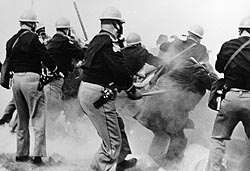
In fact, Rush is correct in remembering that gunplay in the civil rights era was largely the province of white folk. And if all the black people had actually unlimbered all the "Saturday night specials" they were supposedly so ready to use on one another, civil rights would just be another distant dream, something we'd like to try someday were it not that those black folk had proven so trigger happy back then. But in fact, Selma looked like this on the day to which Rush refers:

(Not the 'Crimson Tide's' backfield)

If John Lewis had used a gun that day, he would never have been "beat upside the head" - he'd be dead. Nevertheless, in the experimental spirit which Rush has invoked, try this:
  • If a lot of Abyssinians back in the ’30s had guns and the legal right to use them for self-defense, you think they would have needed to worry about Mussolini's air force? I don’t know. I’m just asking. 


  • If a lot of Ghandi's Indian followers back in the ’20s had guns and the legal right to use them for self-defense, you think they would have needed to worry about the British army? I don’t know. I’m just asking. 


  • If a lot of Gauls and Visigoths and Huns back in A.D. 250 had guns and the legal right to use them for self-defense, you think they would have needed to worry about the Roman Army?


  • If a lot of Afghani warlords back in 2003 had guns and the legal right to use them for self-defense, you think they would have needed to worry about the U.S. Army?

"Holy shit, where'd they get that?"

  • If a lot of Pakistani tribal villagers back in 2010 had guns and the legal right to use them for self-defense, you think they would have needed to worry about the U.S. Air Force?

"OK, I think we've got the equation tighter."

There's a peculiar illogic to all of this that allows us to go pretty much anywhere we want. But who'd really want to end up there?

Eat This Diner

 "Eat it before it eats you."

Every time a sucker is born, which according to verifiable medical opinion and Pew Foundation polling results is about one a minute, another restaurant bites the dust. It's enough to make one believe in intelligent design - the one being made expressly for the other, after all. And vice versa.

Embedded in the anthropoid psyche is some primal flaw, some weird evolutionary anomaly, which is the nearly universal conviction among members of the species that he or she can profitably and happily operate a restaurant. This conviction is nearly always attended by its corollary, that while I (meaning anyone who's thinking this) might be able to run a thriving eatery, anyone else (meaning you) would probably be out of business in a month. Clearly there's something to this lemming-like urge - the combination of warm, savory food and congenial atmosphere strikes some deep chord in every large primate.


And anywhere you look, there's a restaurant for sale, a forlorn hulk sitting like a specter of financial ruin on any street corner, often with the previous menu spangled across the seedy exterior. And no matter how unprepossessing a bit of real estate it may seem, never mind that it's the flagship of a capsized empire, there's invariably some poor sap who heeds the siren call and thinks, "Hey, why not broasted chicken? Sure, I could make a go of this place - a lick of paint, maybe a few new windows and Bob's your uncle!"


And we'll all be rich, you'll see. Never mind that broasted chicken or "Peking-style" duck or catfish fritters or hog jowls and grits didn't make the place go the last time. This time will be different because . . . because there's this restaurant sitting here and I a) can fry an egg as well as the next guy, b) will only use real butter c) am sick of my job, d) ain't got a job, e) am just about to not have a job, f) need something for my freeloading nephew/uncle/sister-in-law to do, or an infinite number of specious reasons why I should alter my existence after some manner in all probability disastrous.

The "Miss Flo," Florence, MA

I'm reminded of this particular human foible because there is, in the rural cowtown of 350,000 souls where I happen to reside, a miniscule diner which has been the bane and peril of several lives in the past two decades. It has had countless reincarnations as various hash houses and most recently as a soul food diner - all this rich history of foundered souls despite its being so small that plates of eggs and potatoes had to be carried out the kitchen door and around through the front door to serve waiting customers; and in the apparent indifference, among its various sequential owners, that about fifteen years ago police were called to the back door to haul off the murdered corpse of the unfortunate who owned it at the time.

Anyway, in case you happen to be reading this, it's for sale. Just thought I'd mention it as, you know, an opportunity.

Wednesday, January 16, 2013

Ollie and Lena's Big Vacation

"Perhaps they were just sick and tired of living at the ends of the earth and having almost nothing but seals to eat."  
- Niels Lynnerup, anthropologist and forensic scientist, University of Copenhagen (explaining why the Vikings left Greenland)

"Get me outa here!"

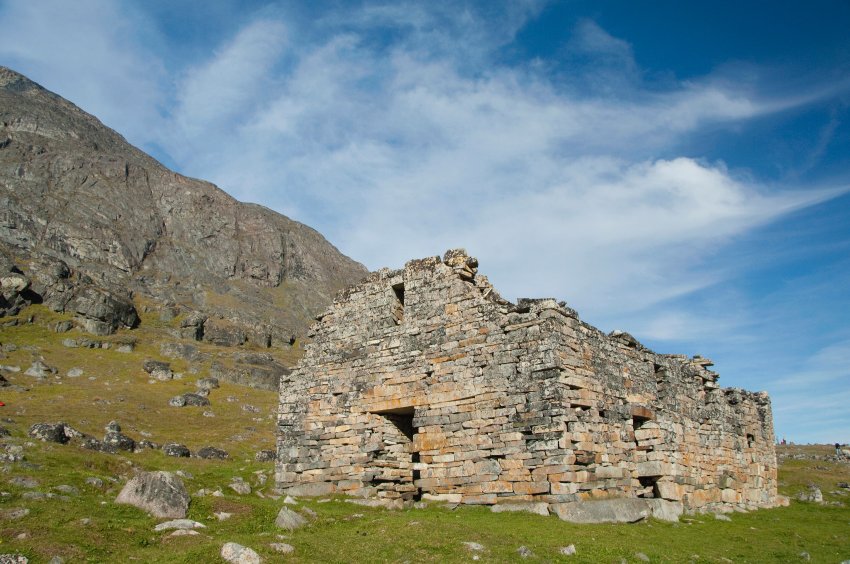
Speaking for myself, I'd say that about sums it up. Oh - perhaps I should introduce myself - Ollie Olafsson, about the last person in this godforsaken place. The wife has been bugging me to move someplace warm, so next week we're catching the last boat out of here for Iceland. We visited Iceland a few years ago and thought it was really nice. You know how it is when you're on vacation - seems like the livin' is easy and you could just stay forever, so we decided to chuck up everything and follow the sunshine, if you see what I mean. Fact is, most of the old neighborhood is looking pretty rough, what with the stone walls gone all crazy and the roofs fallen in.


I never could figure why anyone came here in the first place. Start a rock farm but not much else. I guess it was a bit balmier a few centuries back when they sold building plots here and everyone was dying to get out of Norway, start a little organic vineyard and artisanal cheese operation. Still, how they could ever sell this place as "Greenland" beats all. The gumption these salesman have is something, I tell you. Nothing "green" about this dump, unless you count the moss on the rocks.

They shoulda spotted something was wrong when the only people they ever run into hereabouts was these Inuits, who'd just stand around in little knots, staring like eedjits before they'd bugger off again in their walrus-hide boats. Oddest bunch of people, I tell you. Annoying is the word. Keep the damn whale-and-walrus market and welcome to it, was my take on the matter of Inuits.


Well, and I mean it was one damn thing after another - first it started to get colder, not all at once but over a few decades the mean temperature dropped like a stone. "Mean temperature" is about right, about as mean as it gets. So all the cows died and everyone went to sheep and goat herding. But hell, I'm not a shepherd, never was cut out for that business. I'm a cow man, always was. Daddy always said, if you can't make cheese out of it, it ain't worth putting in a skin bucket. And then damned if all the sheep and goats didn't up and die. Okay by me, says I to the wife.

Which left seals. Seals every darned place you looked. Couldn't hardly walk about the place without stepping on a seal. And you can't herd the consarned things, most contrary animal I ever saw outside of a goat maybe. Try to move them along, they'll all lie down and bask or whatever the hell they call it that seals do. Or wake 'em up, they'll all head straight for the water and bask in it. No managing the damned things. Sure, they're all organic and free-range and what have you, but that comes at a price if you get my drift.


Best way to manage a seal, far as I can tell, is kill it. Then eat it. Which gets old real quick. There's nothing like a steady diet of seal to make a feller smell funny overnight. Keeps the wife in the next room, which a feller don't want all the time, if you see what I mean.


 But once we started dealing in seals, no one ever stopped on the beach any longer - never saw another boat come by, trading dried up, you couldn't get nothing - axe, adze or augur - for love nor money. Worst of it is, we ain't even played in a Super Bowl since 1976. Never mind won a Super Bowl.

Saturday, December 29, 2012

Shagging the Schnauzer

This summary is not available. Please click here to view the post.

We Are the Caterpillar

Scientists in the Netherlands have discovered a species of "hyperparasitic wasp," meaning a wasp that lays its eggs in parasitic wasps that lay eggs in caterpillars. These hyperparasites are sometimes parasitized by other hyperparasitic wasps, a potentially infinite regress of parasitism. “A common enemy of a hyperparasitoid therefore is another hyperparasitoid," notes the Dutch researcher. A caterpillar may play host to two, three, maybe even four tiers of parasites, a veritable daisy chain of staged mortality, one resource depleted by the next.


It's a perfect allegory of corporate capitalism. Here's how it works. Let's say that, a few years back, some poor sap succumbed to the blandishments of Citibank or Wells Fargo and unwisely took out a mortgage which was, in his private economy, highly leveraged - high risk, as the banks used to phrase it back in the day when banks were required to calculate risk. The holder of the mortgage then bundles it up with other high risk mortgages and sells the bundle on the market as a financial derivative. It is purchased by the high-return mutual fund in which the hapless and unsuspecting mortgagee owns shares. When the holdings of the mutual fund prove worthless, the cancer spreads back to the bank, which now holds toxic paper it cannot sell. The bank's assets are heavily devalued and the bank faces financial ruin.

To avert the cataclysm, the bank politely reminds the Treasury Department that its failure will mean economic disaster for the entire country - other markets which depend on the bank's solvency will collapse and ruin will spread across an innocent population in the shape of widespread home foreclosures. America will become a nation of citizens sleeping on sidewalks. The offending bank is concerned, however belatedly, about the plight of its fellow citizens (banks being people too, my friend).

Bankers Without TARP

So Presidents Bush and Obama, in succession, go before Congress to plead for public funds to keep the insolvency at bay and the banks afloat. The money is required, Congress is assured, to help countless unfortunates with their mortgages. Eventually, Congress commits something in the neighborhood of $3 trillion in assistance, part of which was earmarked for mortgage assistance. The money was quite naturally drawn from public funds contributed in part by mortgagees whose mortgages were submerged by the banks who received the money. 

The Treasury Department now holds a large sack of money, part of which is to be disbursed to the banks to help their mortgage holders, another part to buy up the toxic assets the banks had created in the first place. The banks, with the complicity of the Treasury Department, keep the money and use it to leverage further investments, which remain legal. Since the banks cannot qualify for bailout money unless they are solvent, they use one federal bailout program to make themselves solvent enough to qualify for other bailouts - in effect double dipping the bailout money. Between the Treasury Department and the banks, the foreclosure epidemic was allowed to proceed largely unchecked, making the banks more solvent than before the crisis they manufactured.

Who says we can't make anything in this country any more?

Monday, December 24, 2012

Merry Xmas

Great Bores of the Modern Age: A 2012 Catalog

During the year now ending, the following people, parties and institutions (in no particular order of self-importance or malign influence, and in varying degrees from comical to murderous) have proven themselves to be utterly delusional, increasingly impotent and irrelevant, waging rear-guard battles against a functioning society and a peacable world. They are defending a moral and political order which will continue to erode, change, and finally shed them.

1. "Crazy Wayne" LaPierre
"If it's crazy to call for armed [police] officers in our schools to protect our children, then call me crazy. I think the American people think it's crazy not to do it. It's the one thing that would keep people safe." Huffington Post, 12/23/2012


 2. Pope Benedict XVI, "Cavalleria Vaticana"
"The pope pressed his opposition to gay marriage Friday, denouncing what he described as people eschewing their God-given gender identities to suit their sexual choices – and destroying the very 'essence of the human creature' in the process." (Huffington Post, 12/21/2012)


(Update, January 1, 2013): HuffPost reports that in the Pope's New Year's Day speech, he "denounced the prevalence of a selfish and individualistic mindset which also finds expression in an unregulated capitalism, various forms of terrorism and criminality." How can you fault someone entirely who recognizes the eqivalence between those three modes of human endeavor?)

3. Antonin Scalia, Time's Man of the Year, 1542
"The death penalty? Give me a break. It's easy. . . . Homosexual sodomy? Come on. For two hundred years, it was criminal in every state." When a 2003 Texas sodomy law was struck down Scalia nearly went postal, claiming that this would cause "a massive disruption of the social order," equivalent to legalizing bestiality and incest, disruption of the social order being by its very nature, in the jurist's view, illegal, or unconstitutional, or messy at the very least, like suffragism, or trade unionism, or atheism.

"It [the Constitution] isn't a living document. It's dead, dead, dead, dead."

"In the 1960s, Nino Scalia would’ve ended up teaching at Notre Dame law school (where he belonged) — a crackpot speaker on a marginal rubber-chicken circuit that mainstream America could have blissfully ignored, instead of sitting on the highest court in the land imposing his 16th-century will on the rest of us." (Michael Tomasky, The Daily Beast)


4. Benjamin "Bibi" Netanyahu, the Lion of Zion
"Israel pushed ahead with aggressive new settlement building . . . , brushing aside a growing chorus of international opposition, including criticism by its Western allies, that the move threatened to destroy the peace process with the Palestinians.

"Prime Minister Benjamin Netanyahu of Israel seemed unbowed by the growing criticism. He told the ambassadors from several Asian nations on Wednesday that his government would continue to build across Jerusalem — as did its predecessors. 'Jerusalem has been the capital of the Jewish people for 3,000 years,' Mr. Netanyahu said, according to a statement released by his office." (New York Times, 12/19/2012)


5. Vladimir Putin, the Gazprom Queen
"Putin has repeatedly supported the sentence against Pussy Riot. Three of the band's members – Maria Alyokhina, Nadia Tolokonnikova, and Yekaterina Samutsevich – were sentenced to two years in prison in August for singing an anti-Putin "punk prayer" inside a Moscow cathedral. Samutsevich was later given a suspended sentence and released."  (The Guardian, 11/16/2012)

". . . [I]nnovative cultures don’t do things like throw the punk band Pussy Riot into prison for two years for performing a “punk prayer” in a cathedral. That sends a bad signal to all freethinkers."  (Thomas Friedman, New York Times, 12/18/2012)
 

6. Bashar al-Assad, the Syrial Killer
"Ecuador's president, Rafael Correa, has already shown he's not afraid to offer shelter to a controversial figure, by granting political asylum to WikiLeaks founder Julian Assange. Correa this month said he would be willing to consider extending the same protection to Assad. 'Any person who requests asylum in Ecuador, we will consider as a human being whose basic rights we must respect.' Israel's Haaretz newspaper has reported that Syrian Deputy Foreign Minister Faisal al-Miqdad has visited Ecuador, Venezuela, and Cuba in recent weeks, to discuss the possibility of granting refuge to Assad, his family, and his inner circle." (The Week, 12/17/2012)


7. Grover Norquist, the Bathtub Killer
"There was a time when almost every single elected Republican in Washington and even state capitals would sign Norquist’s anti-tax pledge, which binds elected officials to a promise not to raise taxes under any circumstance. As recently as last year’s negotiations over the debt ceiling, Norquist had fealty from a majority in the House of Representatives . . . . Those who violate his pledge could long expect to face attack ads aimed at unseating them, bankrolled by Norquist’s massive war chest. Americans for Tax Reform spent almost $16 million on independent expenditure ads in 2012. Crossing the group has always increased the likelihood of a primary challenge.

"But times are changing. . . . Norquist faces an unprecedented rear-guard attack as the congressional GOP fractures on the tax issue. Last year, there were 238 members of the House and 41 members of the Senate who had signed Norquist’s pledge. This year, there are just 217 in the House — one shy from the 218 needed for a majority — and 39 in the Senate, an all-time low. . . . [W]hile Norquist claims his army is 219 strong in the House, two of those members have since disavowed Norquist’s pledge." ("Is It Game Over For Norquist?"  Salon, 11/14/2012)


8. The Republican Party (BYOB)
"What force can change it—can stop Republicans from being ideological saboteurs and convert at least a workable minority of them into people interested in governing rather than sabotage? With the failed Plan B vote, we have reached the undeniable crisis point. Actually we’ve been at a crisis point for years, but this is really the all-upper-case Undeniable Crisis Point. They are a direct threat to the economy, which could slip back into recession next year if the government doesn’t, well, govern. They are an ongoing, at this point almost mundane, threat to democracy, subverting and preventing progress the American people clearly desire across a number of fronts. They have to be stopped, and the only people who can really stop them are corporate titans and Wall Streeters, who surely now are finally beginning to see that America’s problem is not Barack Obama and his alleged 'socialism,' but a political party that has become psychologically incapable of operating within the American political system." (Michael Tomasky, The Daily Beast, 12/23/2012)

Scared? We ain't scared. We're all white.

9. John "My Fellow Prisoners" McCain

by Donkey Hotey

10. Donald "The Donald" Trump


Mouth agape, "badger" hair style, bad nose job, cheesy tie - no caricature could match the original. Oh what the hell, let's give it a try . . .