Showing posts with label Flyfishing. Show all posts

Friday, April 13, 2012

South Park is not on TV

Earlier in April, on the heels of a March that broke all the records for warmth and sunshine, I decided to go trout fishing in South Park. "Trout fishing in South Park" is neither the same as the similarly named Richard Brautigan novel, nor as much fun as it sounds.

That 'South Park'? 

This is not the South Park where, in an idyllic mountain setting, the population is a heterodox, multicultural gallimaufrey of a Republican's worst nightmare, where the school principal is a transvestite, the school cook is a black man with an army pension who doles out sage advice about living, the school guidance counselor ("M'kay, you kids can't grow commercial quantities of marijuana in the boiler room, m'kay?") is as confused and ineffectual as most of the parents in the town, where there are intergalactic interventions, stranded Congressional delegations, attempted political assassinations, military coups (all nations welcome), jurassic monster attacks, gay motorcycle gangs, alien landings, hormonal feminist takeovers - still, and for all its doubtless charm, a town which for all intents and purposes is run by eight-year-old Eric Cartman . . . 

 Cartman

. . . with the help of Kenny, Kyle and Stan - when Kenny is alive, that is (Kenny is accidentally slaughtered in nearly every episode but, like Jesus, he reappears each week to become the contemporary archetype of the Man of Sorrows and the Resurrected). The foursome invariably dress in the same clothes, indoors or out, summer and winter alike, which is how I can tell it's a TV program. This little touch is known as 'realism,' since the actual weather in South Park warrants such prudential sartorialism.


Sorry, there is a real South Park. Actually it's the same South Park as the one in "South Park." I'm usually sure when I'm in the real (nontelevised) South Park, since the real one doesn't have any trees at all, and people's eyeballs look a little different.

 South Park (TV version)

The real South Park looks like hell or the moon, whichever you prefer, or whichever season you happen to stumble through it. It's in Park County, Colorado, which acquired its name by including this planetary monstrosity - a South Park of moonscape, endless expanses of montane prairie grass grazed by pronghorn antelope unwittingly trespassing on buffalo ranches, the precinct of coyotes, dead cattle, derelict autos, trailer homes with most of their siding blown off, howling winds and epic storms at any time of the year. 


The actual South Park, Colorado
 
In fact, the very place where I chose an idyllic spring day to try out my new inflatable (and properly inflated) plasticized, rubberized, galvanized, vulcanized, polymerized, butyelthylized, polyethelyized, cordite/graphite-clad, unpuncturable, unsinkable, damn-near uninflatible canoe. With conveniently collapsible paddles, courtesy of WalMart (paddles, not canoe, by way of apology and moral defense).

 The invincible 'Colorado'

South Park contains several reservoirs belonging to the Denver water system, each a windswept, shallow expanse of water fed by the South Platte River. Floating across these lakes while languidly casting a flyrod can be, on the pleasantest of days . . . well, tolerably pleasant.

Since I was heading for a state park I stocked up on some cash for the seven-dollar entry fee. When I asked at the gate if they could change a twenty, the park rangers looked at me, looked thoughtful, grinned accommodatingly. They thought for a bit more, explained that they'd made change for someone earlier in the day. I continued to stare at them. One of them brightened a bit and asked if I had a ten. He thought he might be able to make change for a ten. I didn't.
  
So, eighty miles from my front door, even though the wind was howling across the parking lot, foaming up the lake, ripping unstopped along that entire general part of the state of Colorado, I thought I'd driven far enough that I should give it a chance. Two miles back along dirt roads to the small country store (flies, cheap fly rods, cheap fly reels, Power Bars, lip balm and potato chips) to see if the till could make change. The clerk, a nice enough lady, looked into the middle distance, sighed, looked at me, asked if maybe I had a ten. She might could make change for a ten. I felt like I might as well be trading in pelts or cowry shells instead of federal reserve notes that remind us with each cash outlay In Whom We Trust. I decided not to bring God into it and instead suggested I might be able to use a couple of flies. Cost me two Wooly Buggers at about $2.50 apiece (which I can tie by the dozen) to get enough change to get into the park.


WB 

Once through the gate, the wind soaring, I prepared for my first outing - 'maiden voyage' seems a bit overblown when we're talking about a mail order plastic and presumably unbreachable artifact, so I'll just call it a first bang - I decided to 'have a go,' as they say in some circles. This in spite of the fact that fellow anglers I'd seen earlier casting from the shallows were leaving in a steady exodus, offering me little encouragement in my recreating.

Off the back of my pickup came the canoe, down to the water's edge, the wind trying to loft it up and sail it off somewhere, I gamely holding on, beaching it and anchoring it down while I retrieved my flyrod from the truck. I don't know why I thought I would simply be able to clamber aboard and paddle off - each attempt to leave shore, or get within five feet of shore, was foiled by the wind. While I was thus beached, the mother of all thunderstorms rode in, the sun was gone, the wind became nastier, the rain pelted me for thirty seconds before it turned to a driving, stinging sleet.


I'd had enough. For my seven dollars and two new flies, I never got my line into the water. On the other hand, I didn't lose any flies either, but I'll never see that twenty again.

Thursday, April 7, 2011

River of Screams: Why I Fish the Arkansas

Just back from two days on the "River of Screams," which is how in weak moments I refer to the Arkansas River. In the guide services brochures, the South Platte is the "Dream Stream" - I guess because the fish are so large, correspondingly dim-witted, and because it helps to have some marketing when you need to sell guide packages . . . 

Average day on the South Platte

. . .  whereas in the Arkansas, the fish are middling-sized, smarter than the average 10-year-old, and are what I call "entomologically specific," or (not to put too fine a point on it), "damned partiklar as concerns their diet." So more often than not I come home cursing the Trout God (which somehow I always expect will be me), the specific River God (depending on how the flow has been ordered and whether I have managed to keep my footing), numerous Insect Gods (whether for manifesting themselves or not I scarcely ever can predict), and of course the multifarious little gods and demons of wind, weather, sunlight and shadow - I generally wish the entire busload of them at the Devil. 

Not on this little foray into the wilds, however. I was blessed with the kind ministrations of the entire agency of godheads, not to mention an obliging audience of Salmo trutta (fario) in the 14-17 inch class. Which is about as big as they generally get in the Arkansas, and probably why it isn't called the "River of Dreams" because who dreams of small fish (no, on second thought just ignore that).

My Salmo trutta (fario) were bigger than this

First you should know that the river begins ("finds its headwaters" as the touristic sites tell us) in the mountains above Leadville, and is fed by tributaries flowing out of the Sangre de Cristos, which have a snowpack until July 1. So I never wade without waders of some sort until maybe August, when it feels safe to walk around, with some feeling in my extremities, in my nifty no-slip water sandals:

I've never slipped in these

Then you should know that most of the river bottom is covered in boulders which may have been there, growing smoother and slicker (as have fly rods, obviously) since the Late Pleistocene . . . 

No relation (with flyrod)

. . . the current is generally faster than you thought it might be, faster than it looked, than you thought your hip waders could handle, than you brought dry clothes for, than it is in Denver - remember, this is not the "Dream Stream." It can get unruly in a hurry.

River of Dreams (admittedly in the middle of Denver)

But late spring is the season of golden stone flies . . . 


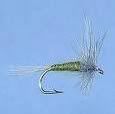
and little green caddis larvae . . .


both of which I had in my scraps of tackle, which I keep meticulously in a series of labeled plastic grocery bags with occasional used flies which I seem to remember tying but always look as though they were purchased by a drunken charwoman at a rummage sale . . .

"I'll just have two of the wee tiny green thingys, and a pint of vodka."

. . . and the way it's done is to tie on the larger fly (the golden stone, in this instance) to your tippet, then tie a piece of tippet on the hook bend of your first fly, tie the smaller fly (the green caddis larva) onto the trailing tippet, and then toss the mess into a current of 3-5 feet, mend the line so that the contraption floats with the water and not with the drag the current puts in your flyline, and watch the tip of your line to see if it stops unaccountably or veers off in some direction that fails to correspond with the current in which you are fishing. Any such veer or arrest in its progress generally indicates interest in your wares, in which instance you raise the tip of your rod and hope to feel some weight as it comes up.

On this foray I was able to spend the cooler mornings trailing nymphs down the current, watching my line veer this way and that, and then spend the warmer afternoons fishing alongside the current in pools and seam water with dry flies, picking off the risers with a blue-winged olive. I figure by now the Insect God must have owed me a good day.


So there I was, talking to perfect strangers who would pull over and offer me a bit of advice or a place to park my camper where the river wasn't so "overfished." I thought it was all pretty good. And today I think I'm smarter than the average 10-year-old. We'll see.

Saturday, March 19, 2011

Same Water, Different River

Voluntary or enforced, retirement is a strenuous affair when properly managed - it requires vigilant maintenance and brooks no slacking. So after returning from two weeks recreating in Texas, I drove down to the Arkansas River in my camper for a few days of fishing. 

The Arkansas is a schizophrenic flow of water running from Leadville, Colorado and emptying somewhere in the Missouri River (which is mostly in Montana and somewhere other than Missouri). The personality of the Arkansas is split between the western stretch, known as the Arkansas and properly pronounced AR-kan-saw, and the eastern stretch, known as the Arkansas and mispronounced locally as Ar-KAN-sas. They are two distinct rivers.

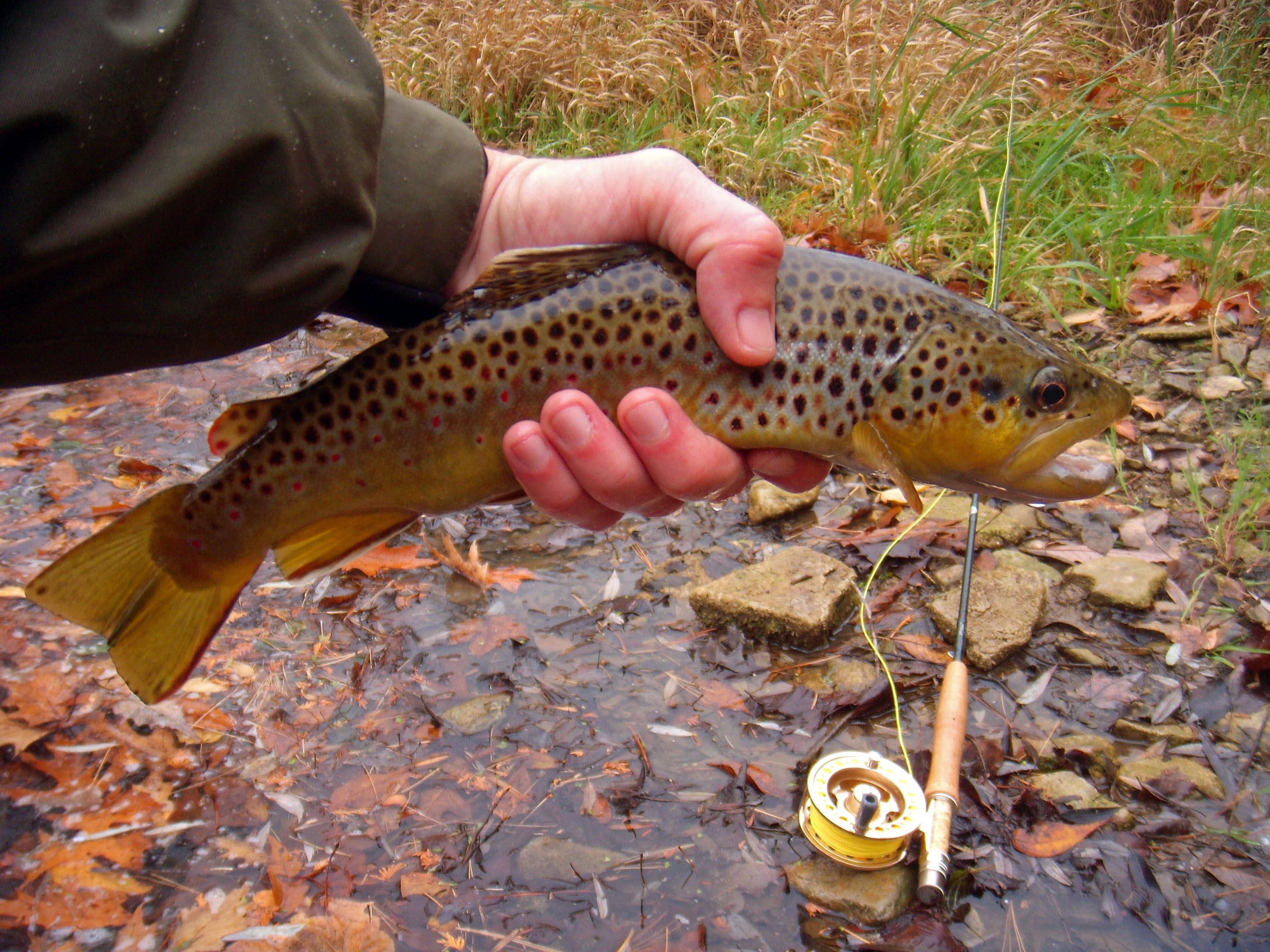
The upper portion of the river, between its source and the dam in Pueblo, is a classic freestone trout stream, clear enough that one can read a Chinese prenuptial agreement in six feet of water, and home to brown trout like the one shown here in the death grip of an amateur's disembodied hand. (I surmise that this is the hand of an amateur because 1) this is no way to treat a lady or an obliging trout, and 2) in his excitement he's thrown his rod on the ground, left his reel marinating in a puddle, and posted a photograph of the fiasco. Not to mention the clean fingernails.)

"GA-AA-CK!"

The lower (Ar-KAN-san) portion of the river is a lazy, muddy meander through sandbars, downed cottonwoods, the hulks of '59 Edsels, derelict washing machines and hot water heaters, harboring catfish of a stupendous size and appetite, as this specimen landed near Quangdong, Kansas amply illustrates (and "amply" is, I think, the mot juste):

1964 Nash Rambler retrieved from Arkansas River

The Upper Arkansas is the precinct of flyfishing with tiny flies, light tackle, stream waders - the usual aristocratic paraphernalia of any tradition-bound endeavor. The Lower Arkansas is the world of "noodling," the pursuit of large catfish by submersion in chocolately-brown water and trying to put your hand securely into the maw of something that, if it doesn't succeed in dragging you into eternity, can seriously abrade your arm. (Baptizing is just "noodling for Baptists.")

"First we dance, then you can buy me a drink."

In any case, I found myself camped along the river, communing with the geese, who float by in pairs and threes. Geese are the RV-ers of the natural world: they park anywhere they like, defecate everywhere, and seem to the innocent mind like a real wildlife sighting.
 
 "Hey, let's just camp here tonight. Bathroom's over there."

I will not discuss my successes or failures in those three days, except to say that by the end of the first day I was feeling pretty frustrated. So when at day's end I did finally land a decent trout in the 14-inch class, I decided that it would be supper. Since it was about to become a piece of history, this fish was clearly of the variety trutta simplistica, which are the only ones ever hooked and landed (generally the ones who think they're still living in a hatchery).  The other common varieties are trutta ascetica (the ones who never eat anything); trutta vegetariana (the ones who never like whatever fly you're offering); trutta bulemica (the ones who promptly spit out whatever goes into their mouths).

Supper that evening demanded some culinary genius, as I was bereft of the usual complement of ingredients that makes a trout on the table what it is - for example, I had brought along on this trip no butter, cooking oil, herbs, eggs, bacon fat, corn meal, and so on. Nothing in fact, except one (nonalcoholic) beer. I decided to make a court bouillon in which to poach the fish. So I diced up the carrot and celery sticks in my larder (intended for lunch the next day), simmered them in the beer, added a packet of Gulden's Brown Mustard for some frisson, and poached the trout.


I won't say I dined like a king, but what with the magnum of Roederer Cristal '85 to start, a complex little Batard-Montrachet '97 with the trout, a half-bottle of Dow's late bottled '64 port and a few rounds of chemin-de-fer at the Indian casino, I did better than the geese in the parking lot. And so (as Samuel Pepys used to say), to bed.

Friday, January 28, 2011

Chernobyl Ants and Twenty Inchers

Now that February is nearly upon us and the western regions are enjoying the benisons of a warming globe, I had thought to totter down to the local freestone water 


and have congress with the resident trout. The Arkansas River, from its headwaters until it reaches the plains of eastern Colorado, is a source of joy and recreation, for me and for about 2500 brown trout per mile of river. And going fishing in early spring becomes more urgent as the cold weather hatches begin and give way to the fabled mid-May "Mother's Day Caddis Hatch," an entomological donnybrook in which caddis flies emerge from the water in honor of American motherhood, and fill the river valley like a blizzard. 

What makes spring angling even more urgent, however, is the impending "rubber hatch." By the first of June the river is bobbing with a flotilla of inflatable rafts


filled with tourists wearing plastic helmets and day-glo Mae Wests, 

 Float My Boat

slathered in various unguents and sunscreens, throwing their gum into the river and behaving like 12-year-olds. The river in spring flood keeps its share of them but never in numbers quite sufficient to abate the annual traffic. Once the rubber hits the river, other quieter civilized pursuits become impossible.

Even more sinister than the rafting conspiracy is the dark plan of the infamous blackguard and professional curtain hanger, Christo, to drape the river under what the locals disparage as "Rags Over the Arkansas,"  six miles worth of silver-ized fabric festooned through a narrow stretch of canyon where the sunlight that spawns a healthy insect population can be at a minimum; the haunt in ordinary times of eagles, osprey and kingfishers. One can at least justify rafting by the profit motive, or the excitement and sense of adventure that come with the prospect of a horrible drowning. Draping a river in plastic has no such rationale beyond the fact that lovers of such spectacle generally buy hamburgers and throw the wrappers along the road. 


 "Rags Over the Arkansas"
Plastic draperies can improve the scenery when festooned from, say, the Coit Tower or the Hoover Dam or the Seagrams Building. But unless it's the Cuyahoga on fire or the Mississippi in the precincts of New Orleans' oil refineries, no river to be at its best needs help from Christo. "Ars gratis artis" doesn't mean the same as "devoid of any point or redeeming feature."  Some of Christo's earlier "temporary" industrial-scale installations remain, like old mining operations, to haunt the landscape. In 1971, he erected the "Valley Curtain" project near Rifle Gap, Colorado, an attempt to drape a heavy plastic curtain between two canyon walls. As the curtain sagged and project engineering proved inadequate, more and more structural materials were trucked in. At least one large concrete supporting bunker is still in place; other concrete formations are sliding slowly down the canyon in a litter of old steel girders and other industrial refuse. It was a Seventies thing, I guess, before Christo knew about Earth Day.

 You see, then, the urgency of getting onto the river before it turns into a veritable gallimaufry of multiple uses.  I pulled out my flyboxes, which are generally by late winter an unsorted litter of flies left over from the fall fishing, flies in various stages of ruffled and unravelling disreputability. Hackles have loosened like a mangy fox stole on a dowager scrap metal heiress; a once immaculate Royal Wulff now resembles Leona Helmsley in a stiffish beeze. I tend to tie the classic patterns, patterns known to work where I fish - black ants and green drake and caddis, pale morning dun and blue-winged olive, serviceable flies named for exactly what they mimic. "Adams" means nothing to the uninitiated, but it's a traditional pattern recognizeable on either side of the Mississippi, named like the Hendricks, the Quill Gordon, the Cahill and the Gray Wulff, for its inventor.

But the newer generation of flies can be baffling. Once you've learned the old vernacular, it's a new country and a new language - what's a Chernobyl Ant? a Woolly Bugger? a micro-flashtail egg? a Red Pig Sticker? a Skinny Minny? Get Stoned? and why do I need to buy foam to tie flies? And is a Twenty Incher what I think it is?

Chernobyl Ant

But maybe this is the best of possible worlds. I'll be able to see a radioactive Chernobyl Ant floating along in the semi-darkness beneath six miles worth of silver-ized fabric.  And maybe Christo will be there in person, rafting downstream without a Mae West.


Update - January 17, 2012: See my newer post at http://shootingafly.blogspot.com/2012/01/rags-over-arkansas.html